


Forced Labour: An Element of the Poverty Cycle
- Admin
- Dec 14, 2020
- 3 min read

Written by: Lesly Magar
Edited by: Georgina Browning

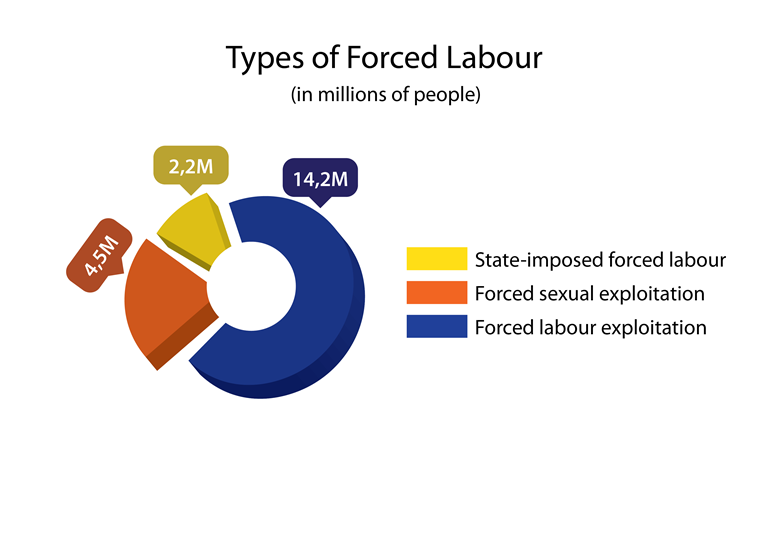
Over 40 million people are estimated to fall victim to human trafficking – a form of modern slavery. While more than a half of the victims are expected to be in forced labour.
What is worth noting although is that these are merely estimates – as per the International Labour Organisation (ILO). Due to its complex nature, we still see insufficient numbers in the detection of such crimes, highlighting the need for greater awareness in the framework of trafficking in persons and accordingly forced labour.
What is forced labour?
By definition, forced labour comprises “all work or service which is exacted from any person under the menace of any penalty” as per the Forced Labour Convention (No.29), 1930.The essential part of the definition being that the victim has not “offered himself or herself voluntarily” to the work.
Although, within the matter of human trafficking, what is of importance is the methods used by the perpetrator for the purpose of obtaining the consent of the victim, to exploit them. As stated by the United Nations Convention Against Transnational Organised Crime, this could be through various means such as by fraud, deception, or coercion etc.
In simple terms, while forced labour is a crime in itself, having its own regulatory instruments, it is also one of the purposes and products of human trafficking.
International Convention on Forced Labour
Having mentioned the most fundamental international instrument regulating forced labour – the Forced Labour Convention No.29, 1930, it would be incorrect to present it as an ideal instrument. FreedomUnited – an international organisation aimed at ending modern slavery – particularly criticises the Convention for being an outdated instrument with many loopholes allowing forced labour to continue.
The anti-slavery organisation therefore urges countries to implement the Forced Labour Protocol and Recommendation which has been adopted in 2014 by the ILO, in order to complement the Convention. With new measures aimed at preventing and protecting victims as well as in detecting the crime itself, this new legally binding protocol sheds some light on a potential step forward in the fight against forced labour.
However, with only 47 countries having ratified the protocol so far, and nearly 7 years down the line, for a global issue – clearly more needs to be done.
Nepal – a source country
Nepal is an example of a country that has yet to ratify the protocol but is in dire need of new measures and policies addressing forced labour. As a developing nation where job opportunities are low and poverty levels are high, Nepali workers are left with no option but to take up jobs abroad. This has essentially resulted in Nepal being characterised as a source country due to the vast number of Nepali victims that are trafficked and exploited for labour.
Amnesty International further illustrates the extent of the issue in their report on the abusive recruitment processes, trafficking and forced labour in Nepal. Through an interview process with 127 Nepali migrant workers and government officials in 2016 and 2017, the majority of the workers were found to have been deceived and abused in relation to their work. Much of which stemmed from the recruitment agency industry, in which the local agents charged high fees to their clients in return for their employment with a foreign employer.
In response, Nepal has issued a ‘Free Visa, Free Ticket’ policy to ensure a limit to the fees charged, while requiring foreign employers to pay towards certain necessities such as airline tickets. However, Amnesty International find that with little to no political will by the Nepali government, the implementation and monitoring of such policies has been considerably poor – while the recruitment agencies continue with their labour exploitative measures.
What needs to be done
As such, what we need to take away from the example of Nepal is that the common efforts of combatting forced labour – where we are constantly presented with the list of brand names we should be boycotting – can only touch on the tip of the problem.
Ultimately, until the protocol to the Forced Labour Convention is ratified and implemented in each country, forced labour will continue to thrive, while assisting the Poverty cycle along with it. There clearly needs to be a greater level of awareness in the different forms of forced labour and the processes that trap victims into exploitative work – in order to alleviate the detection of such crimes. Moreover, greater global pressure needs to be put onto Governments (especially Governments of a source country) in initiating more stringent regulations and monitoring policies to prevent and protect victims of forced labour.


Comments